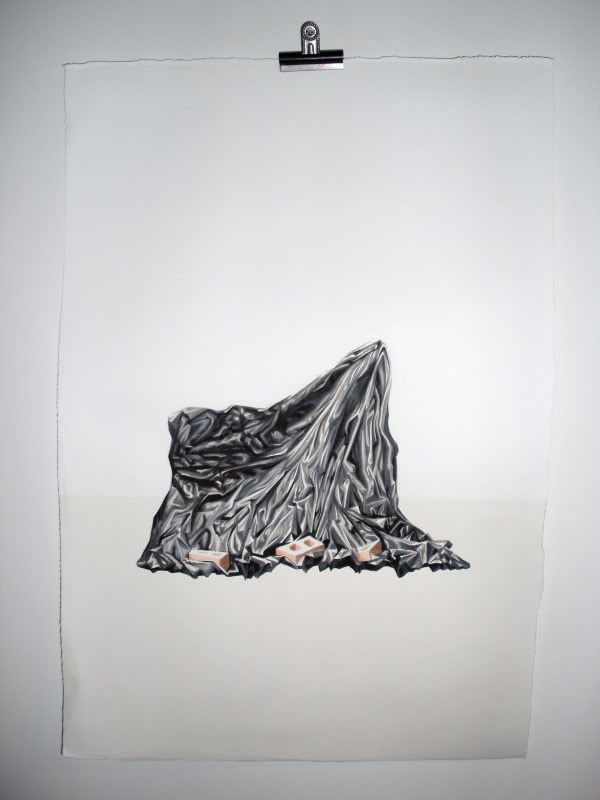
Tarps general use by the public is to cover/protect monuments
during times of construction and harsh weather conditions.
After which they are discarded and thrown away.
Through the hands of the artist,
tarps themselves have been made monumental thought out art history.
Given purpose by the artist, not only to protect the monument,
but to be transformed into the very monument itself.
This process pays homage to the tarp ghost,
to appease their empty souls of lost and forgotten purpose,
by making them whole once more.
To these artists
I pay homage.
-v
 Christo and Jeanne-Claude,
Museum of Contemporary Art, Chicago, Wrapped, 1968-69"Although they had just wrapped the Bern Museum in translucent plastic, the Christos decided for aesthetic reasons to shroud the Chicago museum in greenish-brown tarpaulin, which would give greater physical presence to the building and make a better contrast with the snow."
-Excerpt from the book Christo by David Bourdon.
Harry N. Abrams, Inc., Publishers, New York, ©1970.
Edited and updated by Susan Astwood, June 2000.

Keith Haring.
Untitled, 1983
Vinyl Ink on Vinyl Tarpaulin
120 x 120 inches
305 x 305 cm
Collection The Estate of Keith Haring"Haring began using a vinyl or muslin tarpaulin as a surface for his techno-primitive Pop imagery circa 1981-1982. Painting on tarpaulin was a way of carrying "alternative” Pop sensibility into important ´80s galleries like Leo Castelli and Tony Shafrazi, where he had begun to exhibit at the same time as he began painting on tarpaulin. Unlike traditional canvases, the tarps are not stretched but hung via grommets sewn into the fabric of the painted surface, providing for a continuous expanse of canvas on a monumental scale while retaining the popular dimension so important to Haring."
-From
artfacts.net
Jonathan Jones
untitled (the tyranny of distance), 2008
aluminium, tarpaulin, fluorescent tubes and fittings
6 walls, each 3.4 x 1.9 x 8.27 m."Jones’s use of blue plastic tarpaulin in the SCAF installation is similarly loaded with meaning. Used throughout the world during construction projects, as temporary shelter after natural disasters and as housing for the homeless, blue tarpaulin has a layered set of associations that are rendered more complex through the medium of filtered light."
-Artist statement from
http://www.sherman-scaf.org.au